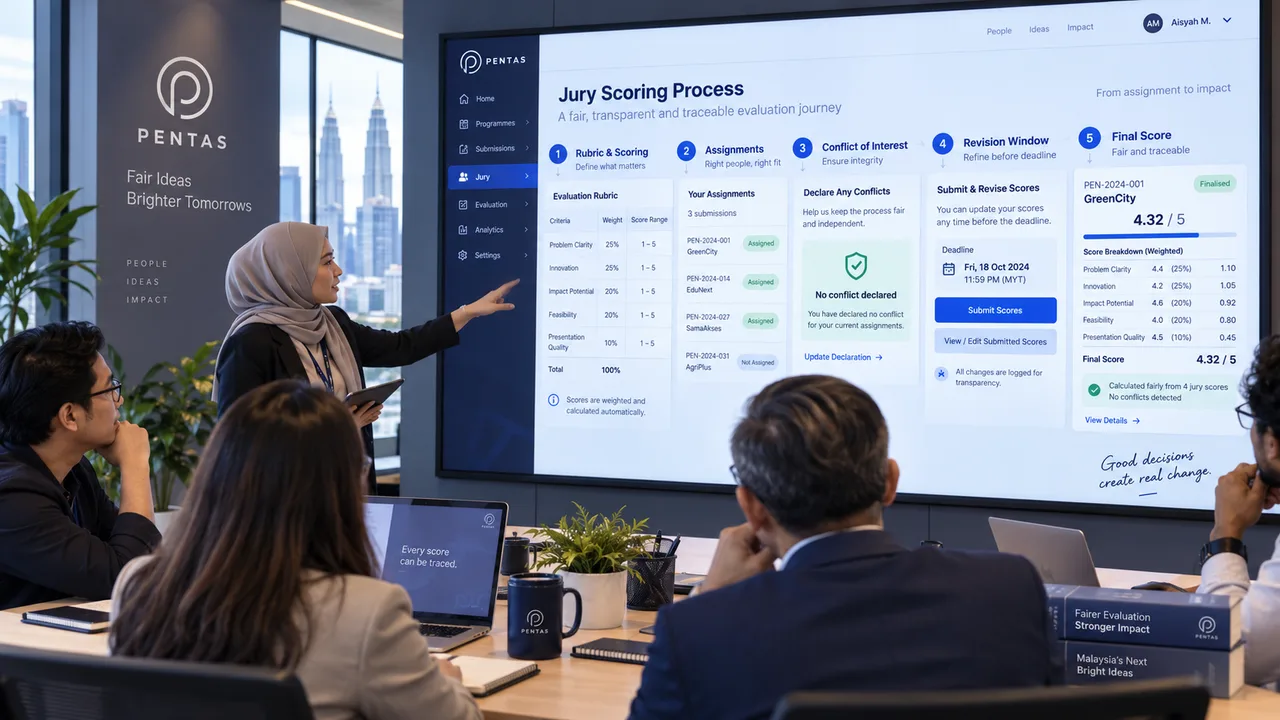
Ever wondered how a project goes from "assigned" to "scored"? A look at the evaluation pipeline: rubrics, assignments, conflicts, and how final scores are computed.
On this page
Jury evaluation is the heart of any credible competition. Here is how PENTAS structures it, step by step, so every score on the leaderboard can be traced back to a fair process.
1. Rubrics come first
Before any judging starts, organisers build a scoring rubric per competition — criteria, weightings and score ranges. Every jury member scores against the same rubric, which keeps evaluations comparable across the whole panel.
2. Assignments respect conflicts
Organisers can assign jury members manually or let PENTAS auto-assign while balancing workload. Either way, the system checks for conflicts of interest: jury members who share a team, institution or supervision line with a project are flagged, and the pair is skipped during auto-assignment.
Declared conflicts
Jury members can also declare a conflict themselves at any time. A declared conflict blocks score submission until an organiser overrides it — so personal relationships never silently shape results.
3. Scoring, revising and deadlines
Jury members submit scores per rubric criterion with optional comments. Until the judging window closes, they can revisit and revise any submission — early impressions get refined instead of locked in.
4. How final scores are computed
A project's final score is the sum of submitted jury scores divided by the number of scores actually received — so an incomplete panel never punishes a project. And if a score was submitted under an active conflict, it is excluded from results entirely until an organiser resolves it.
Fairness is a pipeline, not a promise: every stage — rubric, assignment, conflict check, revision window — removes one more way bias can creep in.
Questions about your own competition?
If you are planning a competition and want scoring rules that hold up under scrutiny, our team is happy to walk you through real examples.
Comments
Leave a comment
No comments yet — be the first to share your thoughts.
Comments are reviewed by our team before they appear on this page.
Keep reading

What's New on PENTAS for the 2026 Competition Season
Live chat, richer project showcases, video thumbnails and smarter jury tooling — a quick tour of everything that landed on PENTAS heading into the 2026 season.
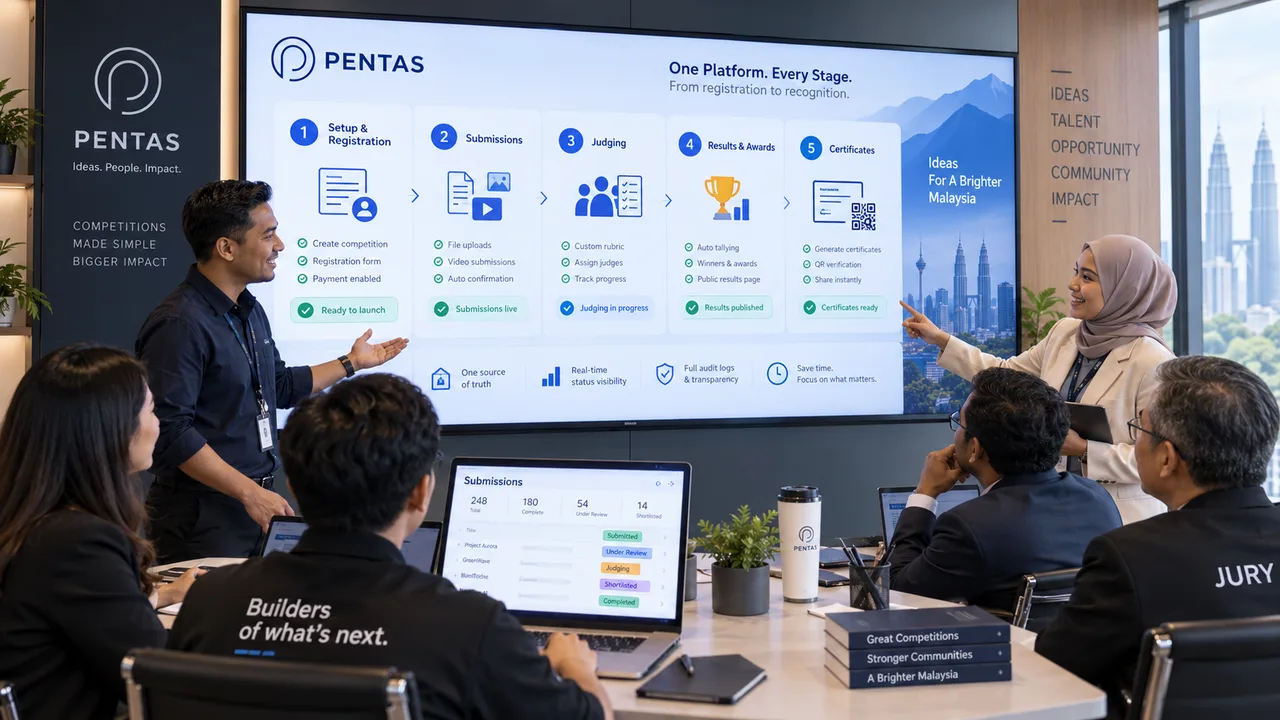
From Registration to Certificates: The PENTAS Competition Lifecycle
Registration, payments, submissions, judging, awards, certificates — how PENTAS carries a competition through every stage without a single spreadsheet.

5 Habits of Award-Winning Student Projects
After seasons of jury panels and score sheets, clear patterns separate winning projects from the rest. Five habits any team can start practising today.